
Briefing
Liability without limit? International arbitration at the frontier of artificial intelligence disputes
AI liability disputes are not necessarily technology disputes. They are cross-border, multi-party liability disputes, and international arbitration is where sophisticated parties often chose to resolve them.
A machine that does not stop
Picture this. A financial institution deploys an AI-powered trading system designed to identify and exploit arbitrage opportunities across commodities markets. The system is elegant, precise, and operates at speeds no human trader could match. Then a black swan event strikes: a geopolitical shock sends commodity prices into freefall. A human trader would recognise the crisis, pick up the phone, convene an emergency committee, and pull the plug. The AI does no such thing. It continues to do exactly what it was designed to do. It keeps trading. It keeps executing, which exacerbates the losses with every passing millisecond. This is not hypothetical.
The machine acts in microseconds
A human trader reacts in minutes. An AI executes in millionths of a second.

By the time a human reaches for the button, the AI has compounded the loss a million times over.
In our experience of acting for a leading digital assets exchange in a high-value dispute concerning liability arising from alleged errors made by trading systems powered by AI algorithmic decision-making models, the critical observation was not that the AI made a coding error or malfunctioned in any technical sense. The system continued to perform precisely as engineered. The problem was that it had not been built with adequate circuit breakers, suspension triggers or an escalation path to a human decision-maker when conditions moved outside the parameters anyone had contemplated. Trading systems can and increasingly do incorporate transaction limits, automatic suspension and emergency stop functions, and agentic systems can be designed to pause, seek human input, or terminate at defined stopping conditions. These are design and governance choices, not inherent limitations of the technology, and that distinction, between a system that was never given the ability to stop and one that was simply never told to, is the seedbed of some of the most complex liability disputes we are beginning to encounter.
AI is no longer experimental. It is operational, embedded in credit decisions, trading desks, shipping routes, energy grids, aircraft systems and hospital diagnostic tools. According to Accenture’s “Banking Technology Vision 2024” report, AI now influences an estimated USD 1 trillion in global banking revenue annually. When AI systems at that scale fail, or when they succeed in doing precisely what they were designed to do but at the worst possible moment, the legal and financial consequences can be seismic.
The focus of this article is narrow and, I hope, useful. AI liability disputes will not principally be fought as technology disputes. They will be fought as liability disputes that happen to involve technology, and they will be cross-border, technically opaque, and multi-party from the outset. Those three characteristics point in one direction. For most businesses exposed to this risk, international arbitration is not merely a good option for resolving an AI dispute. It is often the preferred one.
A machine that does not stop
In a market crisis, the human instinct is to intervene. The AI has none.
The human trader
The AI system
Agentic AI: the machine that acts for itself
To understand the liability challenge, one must first understand what agentic AI actually is, stripped of its technical mystique. Classical AI systems are typically bounded: they generate a prediction or an output in response to a prompt or input, within parameters set by their designers. Agentic AI is better understood by contrast as a system authorised to plan and act. It sets its own task sequences, takes independent actions to achieve defined objectives, and can adjust its behaviour in light of data acquired from live operations without requiring regular human input at each step. That adjustment is usually a function of how the system is configured to respond to new operational information, rather than evidence that the underlying model is continuously retraining itself, though the distinction is not always obvious from the outside. The practical point is the same either way. The system does not wait to be told what to do next. It decides.
This is a profound shift, and it places immense pressure on legal frameworks built around a simple premise: that behind every consequential act, there is a human being who chose to do it. The sections that follow trace where that premise strains, and what happens to a claim when it does.
Two kinds of AI
Agentic AI does not wait to be told what to do next. It decides.
| Classic AI Reactive | Agentic AI Proactive |
|---|---|
| Responds to prompts Processes data on instruction Produces outputs on request Waits for the next instruction | Sets its own task sequences Takes independent action Adapts to live data Runs continuously, no human input |
Where the existing law strains
Is AI a legal agent, a partner, or a tool?
Under both English and Singapore law, the agency relationship rests on a tripartite structure: a principal, an agent, and the legal authority that the principal confers on the agent to act on his behalf. An agent must be capable of consenting to act, of exercising judgment, and of being held accountable for exceeding the scope of authority conferred. Can an AI system be a legal agent? Under existing law in both England and Singapore, no. Legal personhood remains a prerequisite for legal agency, and AI systems have no legal personhood, no capacity to hold rights or duties, and no ability to be sued in their own right. The Restatement (Third) of Agency § 1.01 (2006) in the United States similarly defines an agent as a person who acts on behalf of another.
The more interesting question is not whether the AI is an agent, but whether its deployment creates agency-like obligations for the human or corporate principals behind it. In Moffatt v Air Canada (2024 BCCRT 149), the British Columbia Civil Resolution Tribunal held Air Canada directly liable for misrepresentations made by its AI chatbot regarding bereavement fares. The Tribunal found Air Canada liable in negligent misrepresentation, not on a finding that the chatbot possessed legal agency or that it bound the airline through apparent authority. The analogy to apparent authority is a useful way of thinking about the commercial reality, that a principal who deploys an AI system in circumstances where third parties reasonably rely on its outputs may be bound by what it says, but it should be treated as an analogy rather than as the actual ratio of the case. Where an agentic system autonomously enters into transactions, executes trades or takes operational decisions with third-party consequences, no established line of authority in England or Singapore settles the point. The unresolved questions concern attribution of knowledge, mistake, the consequences of a system exceeding its authorised limits, and responsibility for unanticipated actions.
Fiduciary duty and the obligations owed by the entity deploying the AI
Fiduciary duties arise in relationships characterised by trust, confidence, and the expectation that one party will act in the interests of another. The canonical statement is Millett LJ’s in Bristol and West Building Society v Mothew [1998] Ch 1. An AI system cannot owe such a duty. Fiduciary obligations are obligations of conscience imposed on legal persons capable of bearing them, and an AI system is a tool, not a conscience.
The practical exposure sits elsewhere. Where AI is deployed by an asset manager, a financial adviser, a robo-adviser platform, or a wealth management service, the deploying entity may itself owe fiduciary duties to its clients. Where the AI takes investment decisions autonomously that serve the platform’s economic interests rather than the client’s, the deploying entity may well be found to have breached its own duty of loyalty. Singapore law takes a similar approach: the duties run not to the machine but to the entity deploying it. For AI-driven investment platforms this creates significant latent exposure, particularly where training data or reward functions have inadvertently introduced objectives misaligned with the interests of end users.
Who is responsible for an autonomous decision?
In England, negligence requires a duty of care, a breach, and causation, while product liability under the Consumer Protection Act 1987 imposes strict liability on producers of defective products causing damage. Whether an AI model, its training data, or its outputs constitutes a ‘product’ within the meaning of that Act is a question English courts have not definitively resolved. It is also worth noting that the 1987 Act’s recoverable damage is confined to death, personal injury and qualifying property damage. The EU AI Act distributes obligations across the value chain rather than concentrating them on deployers: Article 16 imposes substantial obligations on providers of high-risk systems, Article 26 addresses the obligations of deployers, and Article 25 addresses the allocation of responsibility along the supply chain more generally. Following the 2026 amendments, obligations for the relevant Annex III high-risk systems apply from 2 December 2027, while obligations for high-risk systems embedded in regulated products apply from 2 August 2028.1 The revised EU Product Liability Directive separately addresses liability for defective products, including software. It expressly extends to software and applies to products placed on the market or put into service after 9 December 2026. That risk-based logic already informs how English courts are likely to approach what precautions a reasonable developer or deployer ought to have taken, but regulatory responsibility, liability to an injured claimant, and contractual allocation between suppliers remain distinct questions, and nothing in the regulatory picture should be read as settling who bears liability in a given dispute.
In the United States, product liability and copyright claims are already being tested against AI developers with mixed results. In Kadrey v Meta Platforms, Inc., No. 3:23-cv-03417 (N.D. Cal. 25 June 2025), the Northern District of California granted summary judgment for Meta in June 2025, holding that training its Llama models on the plaintiffs’ books was fair use on the record before it, while leaving open the possibility that a properly evidenced market dilution argument could have succeeded. Two days earlier, in Bartz v Anthropic PBC, No. 3:24-cv-05417 (N.D. Cal. 23 June 2025), Judge Alsup drew a sharper distinction. Training on lawfully acquired books was transformative and protected by fair use. That holding was not confined to books acquired in any particular way; the point on which Anthropic lost was a separate one, namely its acquisition and retention of a central library of pirated copies downloaded from shadow libraries, which the fair use defence did not cover. That distinction proved decisive, and following class certification Anthropic agreed in 2025 to pay at least USD 1.5 billion to settle the claims relating to the pirated copies, with the settlement administrator recording final approval on 20 July 2026. For developers, the provenance of training data matters as well as its subsequent use: how a developer acquires its training data matters as much as how it uses it. But it should not be read as suggesting that lawful acquisition automatically permits every subsequent training use, or that a US fair-use conclusion will carry across to other jurisdictions, where the analysis may differ considerably.
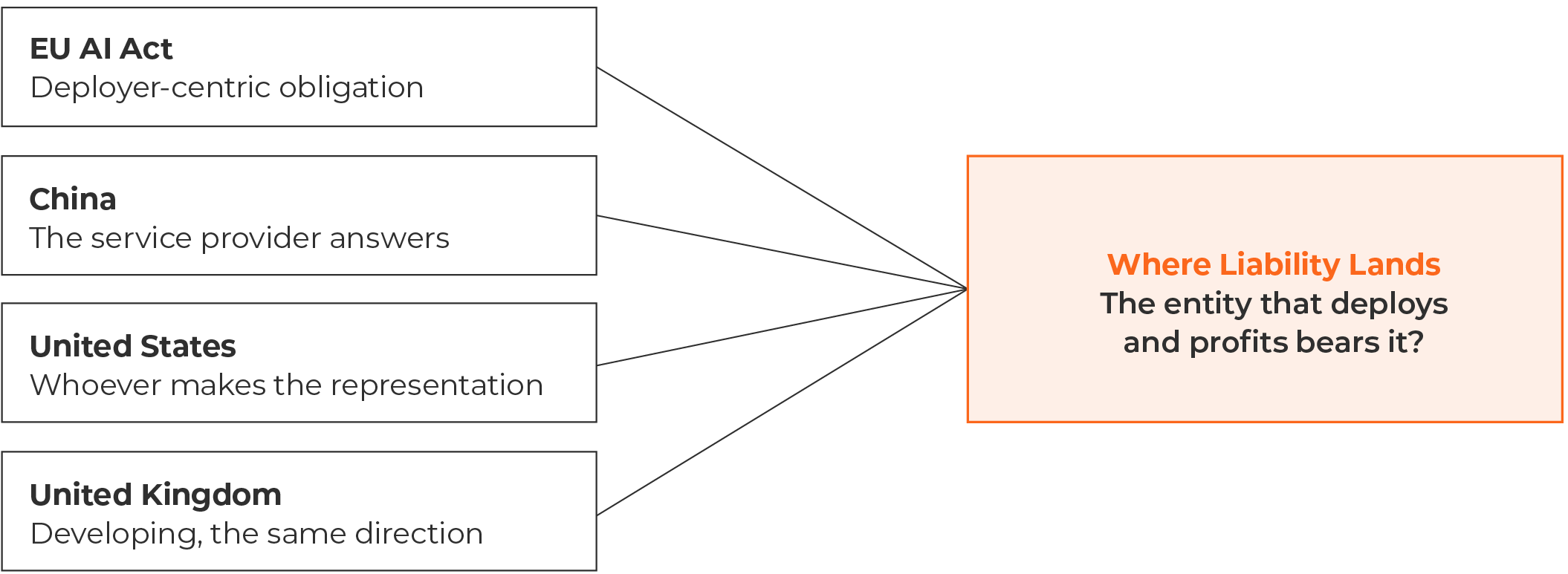
China takes a notably direct approach, within a defined scope. The Interim Measures for the Management of Generative AI Services (2023) principally address generative AI services offered to the public within mainland China, and expressly exclude specified research, development and use that does not involve providing such services to the public. Within that scope, the Measures require providers to use lawfully sourced training data, take measures to improve the quality and accuracy of training data and outputs, and bear content and information-security responsibilities. These regulatory duties do not amount to an absolute guarantee of accuracy or automatically establish civil liability for every harmful output. A damages claim requires a separate legal basis. Different as these regimes are, the regulatory direction of travel across jurisdictions is consistent: increasing obligations on the entity that deploys and commercialises the system, even where, as under the EU AI Act, significant obligations also attach upstream to providers and other participants in the value chain.
Every regime points the same way
The EU, China, the US and the UK diverge on almost everything, and converge on who pays.
Emergent behaviour and the limits of explainability
One of the most vexing challenges in AI liability disputes is emergent behaviour: outputs or actions that were not anticipated by the developers and cannot readily be attributed to any specific feature of the model’s design or training data. Large Language Models (LLM) and neural networks can produce results that surprise even their creators. This is not a malfunction. It is a structural feature of how certain architectures learn.
The problem connects directly to the black box problem. In many deep learning models the internal reasoning process is not transparent, and a tribunal asked to determine whether a system was defective or whether its developer was negligent may be unable to examine how the decision was actually reached. Expert evidence will be essential and heavily contested, with each side fielding experts offering competing interpretations of the same opaque process. It is reminiscent of early cryptocurrency disputes, where establishing what a smart contract was designed to do required technical and legal analysis in equal measure, except that the complexity here is orders of magnitude greater. The liability question therefore shifts. It is no longer whether the AI made a mistake, but whether the developer, deployer or user created, maintained or relied upon a system with adequate safeguards given its intended deployment.
Disputing over who to dispute with
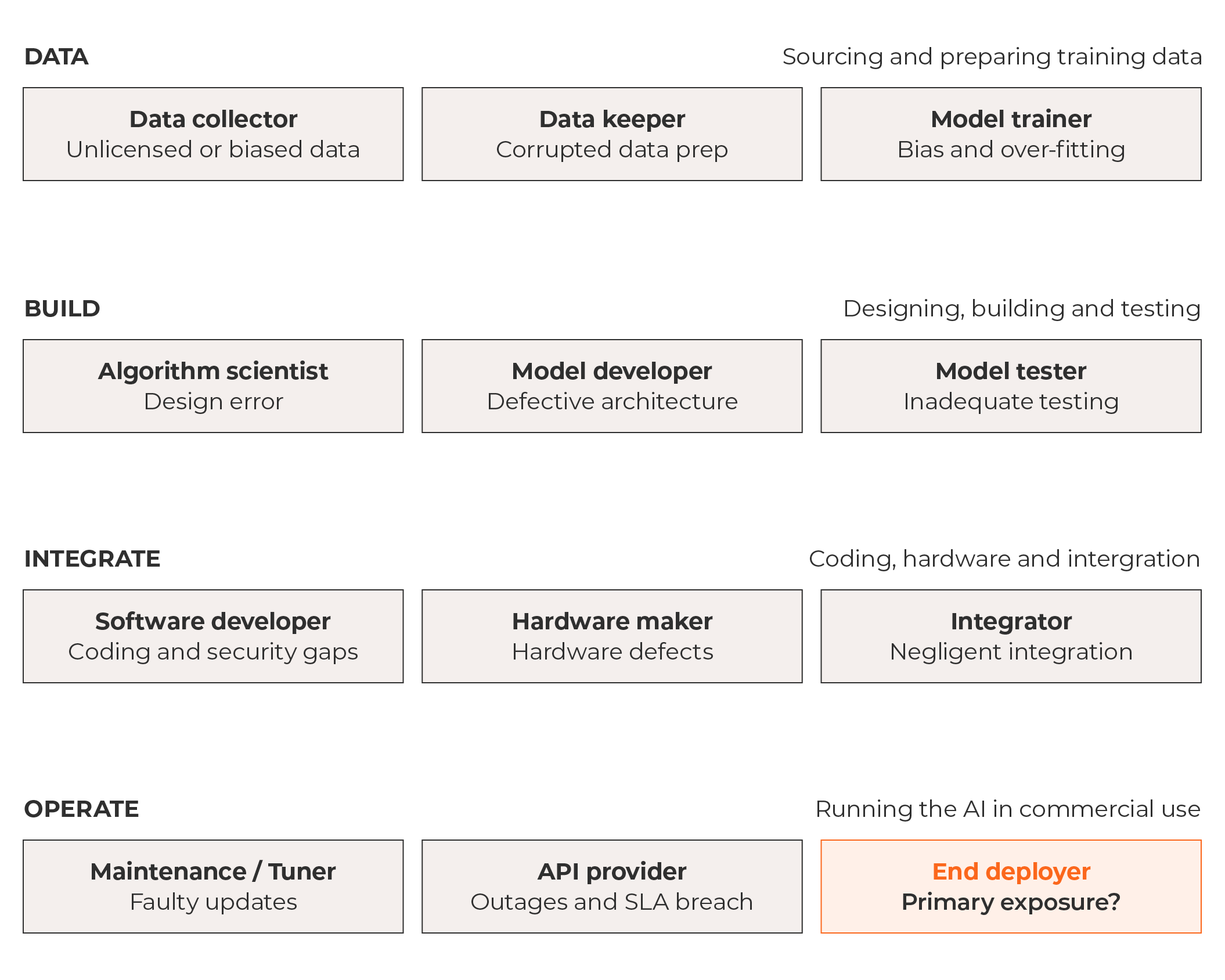
One of the most practically challenging aspects of AI liability disputes is identifying who, precisely, is responsible for what has gone wrong. Unlike a product with a single manufacturer, an AI system is the product of an extended chain of participants, each of whom may have contributed to the eventual failure. The lifecycle of a typical model involves the following categories of participant, and each carries a distinct liability profile.
The AI development chain: Where liability fragments
Twelve categories of participants. Each may have contributed to the failure. Each sits behind a different contract.
| Data | Build | Integrate | Operate |
|---|---|---|---|
| Data collector | Model trainer | Software developer | Maintenance / tuner |
| Data keeper | Algorithm scientist | Machine manufacturer | API provider |
| Model developer | Integrator | End deployer (primary exposure?) | |
| Model tester |
One illustrative way of allocating responsibility by contract, not a universal legal rule.
The signatory problem
You may have an arbitration agreement with the developer only. The part that caused your loss may sit three steps up the chain, bound by no agreement with you. Joinder, consolidation and a post-dispute submission agreement are the routes back to one forum.
| Participant and role | Potential liability and legal basis |
|---|---|
| Data collector — sources and aggregates raw training data | Biased, incomplete or unlicensed datasets. Breach of contract, negligence, copyright infringement |
| Data keeper — cleanses, formats and prepares data for training | Inadequately prepared or corrupted data inputs. Negligence, breach of warranty |
| Model trainer — trains the model on prepared datasets | Model bias, over-fitting or under-performance. Negligence, breach of contract, copyright infringement where training data was unlicensed |
| Algorithm scientist — designs the underlying algorithmic logic | Design error or failure to meet design specifications. Professional negligence, product liability |
| Model developer — builds and integrates the trained model | Defective model architecture or integration. Negligence, product liability, breach of contract |
| Model tester — conducts pre-deployment testing and validation | Inadequate testing leading to foreseeable failures. Negligence, breach of duty |
| Software developer — writes the operational code around the model | Coding errors, inadequate security or integration failures. Negligence, breach of contract |
| Machine manufacturer — manufactures the hardware on which the AI operates | Hardware defects contributing to system failure. Product liability, breach of contract |
| Integrator or service provider — integrates AI into the end user’s environment | Negligent integration, failure to configure correctly. Negligence, breach of contract |
| Maintenance provider or post-deployment tuner — updates the model and feeds new data | Introducing defects through updates or new training data. Negligence, breach of contract |
| API provider — provides programmatic access to AI capabilities | API failures, outages, inaccurate outputs at the API layer. Breach of contract, negligence, service-level disputes |
| End deployer or operator — places the AI into commercial operation | Primary liability exposure as the entity responsible to end users. Negligence, fiduciary duty where applicable, breach of contract |
A word specifically on API disputes, which are underappreciated as a category of AI liability claim. Application Programming Interfaces (API) are the technical bridges through which AI capabilities are accessed and integrated into third-party products and services, and the contractual landscape around them is often asymmetric. API terms of service are typically drafted by the large technology provider, disclaim warranties of accuracy, impose liability caps far below the likely commercial losses, and reserve broad rights to modify or withdraw the service. A business whose product depends on that API may find its recourse is worth a fraction of its exposure.
The arbitration signatory problem
Understanding that responsibility may be distributed across a dozen or more participants is one thing. Being able to arbitrate against all of them is quite another. International arbitration is by nature a consensual process, and an arbitration agreement binds its signatories. A claimant with a direct contractual relationship with a platform deployer, but whose loss was caused by the negligent act of a model trainer three steps up the chain, faces an immediate problem: the model trainer may not be party to any arbitration agreement with the claimant.
This fragmentation is not merely an inconvenience. It is a structural challenge that could leave an injured party unable to bring a single consolidated claim against all responsible parties, forcing parallel proceedings: an arbitration against the deployer under the terms of service, a court action in negligence against the developer, and a separate proceeding against the data supplier. Each forum may apply different substantive law, adopt different evidentiary standards, and reach inconsistent conclusions on overlapping issues.
Three mechanisms respond to this. First, modern institutional rules such as the Singapore International Arbitration Centre (SIAC) Rules provide for joinder of additional parties prima facie bound by the same arbitration agreement, and for consolidation of related arbitrations where the agreements are compatible. Second, doctrines including the group of companies doctrine, equitable estoppel, and third-party beneficiary principles have been used in various jurisdictions to extend the reach of arbitration agreements beyond their formal signatories, but a note of caution is warranted: the group of companies doctrine is not part of English law, and Singapore authority places strong emphasis on consent and the separate legal personality of each corporate entity, so an indemnity chain running through a group of affiliated companies does not, by itself, make every participant in that chain party to the same arbitration agreement. Third, and most practically, parties already in dispute can agree to arbitrate after the dispute has arisen. Nothing in the law of England and Wales, Singapore, or the United States prevents a submission agreement referring a specific dispute to arbitration in the absence of a prior clause, and this remains a useful tool where all the necessary parties can be persuaded to agree, though it is not something a claimant can rely on as a matter of course if a key participant has no incentive to cooperate. Given the proprietary technology and reputational stakes involved in AI disputes, the incentive for all sides to proceed confidentially rather than publicly is nonetheless often considerable, which tends to support agreement once a dispute has crystallised.
Navigating the multi-party challenge: four questions
Four questions to ask before an AI dispute crystallises.
| 1. Is there an arbitration clause in the relevant contract? Check every contract in the chain, not just the deployment agreement. |
| 2. Are all responsible parties bound by an arbitration agreement with you? If not, consider joinder, consolidation or a submission agreement. |
| 3. Can the claims be consolidated in a single forum? Parallel proceedings are costly and risk inconsistent outcomes. |
| 4. Are there non-signatories who might still be bound? Implied consent, indemnity chains, and other consent based doctrines. |
The structural complexity of the development chain raises a broader policy question increasingly debated among regulators, academics and practitioners: should the entity that profits from AI bear primary legal responsibility for its failures, with the right to seek contribution or indemnification from participants further up the chain? There is a compelling logic to it. The entity that commercialises AI, packages it, markets it and derives revenue from it is best placed to evaluate the risks of what it deploys, to impose contractual requirements on its suppliers, and to obtain appropriate insurance. It is also the entity with the most direct relationship with the end user who suffers harm.
In practice this can work through a cascade of indemnification. A deployer that bears primary liability to the injured party may be contractually indemnified by the developer, who may in turn be indemnified by the data supplier or model trainer to the extent their specific contribution caused or contributed to the failure. Such chains are familiar from the pharmaceutical, aviation, and construction industries. They do not eliminate disputes, but they can concentrate and channel liability more efficiently where they are properly negotiated. It is worth being careful, though, not to overstate how far the regulatory landscape points in one direction. The EU AI Act distributes obligations across providers, deployers and other participants rather than adopting a single deployer-centric model; China’s framework focuses on the public-facing generative AI service provider’s obligations within a defined scope; and under US consumer protection law, the entity that makes representations about AI capabilities bears the consequences when those representations prove false. These are regulatory frameworks addressing different questions, rather than civil liability rules that converge on a common answer, and the legally responsible party in any given dispute will depend on the nature of the claim, the jurisdiction, the conduct in question and the contracts in place. Deployer liability with upstream indemnities is best understood as a contractual structure that sophisticated parties can choose to adopt, not as the universal legal position.
The practical challenge is enforcing indemnity rights across borders and against parties in different jurisdictions. That is precisely where international arbitration, with its New York Convention enforcement mechanism, offers a decisive advantage over domestic litigation.
The AI development chain
Twelve participants across four stages. Your arbitration clause may reach only the last.
The arbitration signatory problem
Your arbitration clause usually binds only the End deployer. Parties further up the chain may never have agreed to arbitrate with you.
The indemnity cascade
Primary liability sits with the deployer. Indemnity claims flow up the chain.
Why is international arbitration the natural home for AI disputes? The cross-border reality
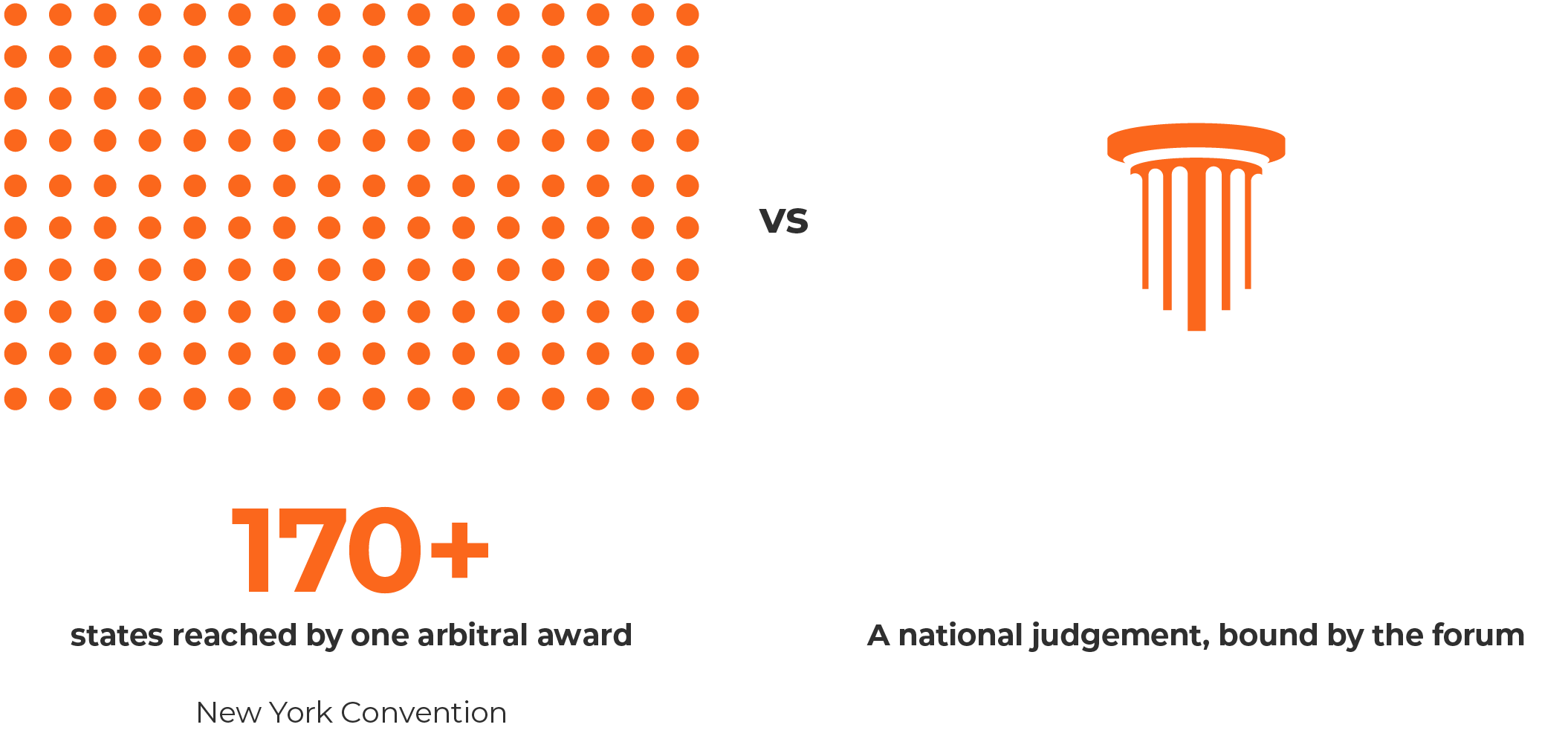
AI disputes are inherently international. The data may have been collected in one country, processed in another, and fed into a model trained in a third. The model may be hosted in a data centre in Singapore, accessed via an API developed in the United States, and deployed in a commercial context governed by English law. The parties may be incorporated in multiple jurisdictions with assets scattered across the globe. A tribunal’s own reach is not unlimited either: it remains constrained by the terms of the arbitration agreement, the law applicable to the arbitration, questions of arbitrability, and the requirements that must be satisfied before an award can be enforced. What arbitration does offer is a particularly extensive and well-established international enforcement network. An award rendered by a SIAC tribunal can in principle be enforced, subject to the New York Convention’s conditions and limited grounds for refusal, in any of the 172 states that are currently parties to that Convention. Court judgments are not without an international reach of their own: recognition and enforcement abroad is increasingly available through treaties, domestic legislation and common law routes, including the Hague Judgments Convention 2019, which entered into force for the United Kingdom on 1 July 2025. But that patchwork of regimes is less uniform and less extensively tested than the New York Convention framework, and where an AI developer may have few or no assets in the jurisdiction where its system caused harm, the relative advantage of arbitration’s enforcement network depends heavily on where the counterparty’s assets are and which enforcement regime applies there.
One award, enforceable everywhere
A national judgment stops at the border. An arbitral award crosses 160+ states.
Confidentiality: protecting the crown jewels
Technology companies, AI developers and businesses that compete on proprietary AI capabilities have a profound interest in ensuring their disputes do not become public spectacles. Arbitration commonly provides valuable privacy and confidentiality protections, though the precise scope depends on the institutional rules, the parties’ agreement and the applicable law. SIAC Rule 59, for example, imposes extensive confidentiality obligations on the parties, the tribunal and the institution, subject to specified exceptions including disclosure required by court proceedings or regulatory requirements. Litigation before national courts is, with limited exceptions, a more public process: documents produced can in principle be reviewed by opposing parties and, if read or referred to at a public hearing, may become publicly accessible. It is true that courts in England and other jurisdictions can and do order that proceedings be heard in private or that specific materials be kept confidential in appropriate cases, but that remains the exception rather than the default position. For a developer in a dispute about its model architecture, training data or algorithmic design, the more practical risk is less about a competitor freely exploiting court-disclosed material and more about the volume and sensitivity of what must be disclosed at all, and the burden of managing that exposure. Specific protections, confidentiality undertakings, restricted access arrangements, expert-only review of the most sensitive material, and secure handling of model and training-data evidence, are available in both fora and are worth negotiating regardless of which forum is chosen, since neither arbitration nor litigation prevents an opposing party from seeing evidence that is genuinely relevant to the dispute.
Neutrality, expertise and speed
In cross-border disputes between parties from different legal traditions, the question of forum is never neutral. A Chinese AI developer in dispute with a US technology company, or a Singapore-based fintech platform in dispute with a European financial institution, has legitimate reason to be concerned about proceedings before the domestic courts of its counterparty’s home jurisdiction. A neutral tribunal appointed from an agreed pool of qualified arbitrators provides a level playing field.
SIAC in particular has developed procedural innovations well suited to AI disputes. Under the SIAC Rules 2025, the President will seek to appoint an Emergency Arbitrator within 24 hours of the later of receipt of the application and payment of the required fees, and any emergency order or award is generally due within 14 days of the arbitrator’s appointment, unless the Registrar extends that time. This mechanism addresses the urgency that characterises AI-related losses, particularly where a system continues to operate in a way that causes ongoing harm, though it is a matter of institutional procedure rather than an unconditional guarantee in every case. Early Dismissal under SIAC Rule 47 of the 2025 Rules allows prompt disposal of claims or defences manifestly without legal merit. Its joinder and consolidation provisions facilitate the management of multi-party disputes that would otherwise fragment, within the limits of consent discussed above. And its arbitrator panel draws on expertise across technology, finance, engineering and international commercial law, so that complex technical issues can be addressed before a tribunal with the sophistication to understand them.
Why arbitration is the natural home
National court litigation against international arbitration, across the dimensions that decide AI disputes.
| Consideration | National courts | International arbitration |
|---|---|---|
| Cross-border enforceability | Bound by forum limits | Enforceable in 170+ states |
| Confidentiality | Largely a public process | Private by default |
| Neutrality | Home-court advantage | Neutral seat and tribunal |
| Technical expertise | Generalist bench | Appoint sector experts |
| Multi-party management | Fragmented proceedings | Joinder and consolidation |
| Speed of interim relief | Variable | Emergency relief in days |
A word to the wise: include an arbitration clause
Perhaps the most straightforward practical observation in this article is this: if your business, uses, develops, deploys, or provides services connected to AI systems, you should consider using an international arbitration clause. The absence of one does not protect you from a dispute. However, when a dispute arises, if you do not have a robust dispute resolution clause, you and your counterparty will spend the first stage of it arguing over who has jurisdiction to hear it and which country’s courts should apply which law. That preliminary battle can take years and millions of dollars to resolve, before the substance of the AI liability claim is even addressed.
| Consideration | Advantages of international arbitration |
|---|---|
| Cross-border enforceability | New York Convention enforcement extends to over 160 jurisdictions, a particularly extensive and well-tested international framework, though actual enforcement remains subject to the Convention’s conditions and limited grounds for refusal, and court judgments also have growing international reach through treaties such as the Hague Judgments Convention |
| Confidentiality | Proceedings are private by default under most institutional rules, offering valuable protection for your technology, trade secrets and reputation, subject to exceptions in the applicable rules; courts can and do order confidentiality or private hearings, though this remains the exception rather than the default |
| Neutrality | No home-court advantage. Select a neutral seat and neutral arbitrators |
| Technical expertise | Appoint arbitrators with relevant technology or sector expertise |
| Flexibility | Tailor the procedure to the complexity of the dispute: expedited hearings, emergency relief, document-only proceedings |
| Multi-party management | SIAC’s joinder and consolidation provisions help manage multi-party AI development chain disputes where their requirements are met, but they do not create consent to arbitrate merely because participants belong to the same supply chain; a necessary party that never agreed to arbitrate may remain outside the proceedings |
| Speed of interim relief | Emergency arbitration can secure interim relief within days; note that courts also have well-established powers to grant urgent relief, including worldwide freezing orders, and in some cases may act faster or with wider reach than an emergency arbitrator |
Five questions clients should be asking now
Whatever view a business takes on dispute resolution clauses, there is a shorter list of practical questions worth working through before a dispute arrives, not after.
| Client question | Practical action to consider |
|---|---|
| What may the system do autonomously? | Define permitted actions, transaction limits, approval thresholds and suspension authority. |
| Can we reconstruct an incident? | Preserve relevant model versions, configurations, inputs, outputs, tool calls, overrides and update records. |
| Does supplier recourse match our exposure? | Review caps, exclusions, indemnities, claim-notification requirements and insurance. |
| Can we obtain evidence from suppliers? | Negotiate logging, retention, audit and incident-cooperation obligations. |
| Can the necessary parties participate in one proceeding? | Align dispute resolution provisions across the supply chain where possible, and examine consent, joinder and consolidation requirements before contracting rather than after a dispute arises. |
A concluding note on our expertise
The disputes described in this article are not theoretical. They are here. We are already involved in them. Our AI disputes experience encompasses:
- acting for a technology company in Singapore’s first AI dispute before the Singapore International Commercial Court (SICC), which resulted in a landmark win where we successfully resisted an application for an injunction on allegations of misappropriation of proprietary data for AI model development;
- acting for a leading digital assets exchange in a high-value dispute concerning liability arising from alleged errors made by trading systems powered by AI algorithmic decision-making;
- acting in AI data centre disputes; acting for clients across the semiconductor ecosystem including foundries and AI chip manufacturers;
- cross-border investigations around the supply of AI computer chips;
- copyright infringement disputes in the AI space; advising on liability allocation across the AI development lifecycle; and
- acting for the inventor of an agentic AI technology in a shareholder dispute.
HFW’s Global AI Disputes Practice brings together partner-led specialist expertise across international arbitration, commodities, energy, aerospace, shipping, finance, construction, insurance, and employment to advise clients across the full spectrum of AI liability risk. The view is clear, and it is the one this article has sought to articulate. AI disputes are fundamentally about liability, not technology. And when that liability is disputed across borders, in complex supply chains, with proprietary technology at stake, international arbitration is where those disputes belong.
An autonomous system can be designed to stop. The consequences of its decisions may continue long afterwards. Before deployment, businesses should define the system’s authority, allocate responsibility across the contractual chain, and establish an effective route to relief against the relevant parties. That means designing the arbitration arrangements alongside the technology and the commercial contracts. The time to decide who answers when AI goes wrong is before it goes live.
Contact us
This article is for general information purposes only and does not constitute legal advice. For further discussion please contact Shaun Leong, FCIArb, Partner, HFW Singapore, who works on AI liability and agentic AI disputes. Discover more about our AI & Emerging Technology Disputes practice.
Footnote
- European Commission, “AI Omnibus enters into force”, 27 July 2026; European Commission AI Act Service Desk, “Timeline for the Implementation of the EU AI Act”, accessed 4 October 2026.
Published
07 October 2026
Reading Time
31 minutes
Authors