
Misrepresentation claims: Unlocking remedies beyond the contract
This article is the second in HFW’s Global Construction Team’s series on extra-contractual remedies in construction disputes across England and Wales, the UAE, Saudi Arabia, Kuwait, Hong Kong and Australia.
In our previous article1, we explored the circumstances in which parties may need to look beyond the four corners of the contract and consider rights and remedies arising from other sources of law, including tort, equity, restitution and statute. The focus of this article is misrepresentation.
Misrepresentation is one of the most significant, and often overlooked, causes of action available in construction disputes. Construction projects are built on information. A contractor’s decision to tender, its bid price, and the risks it is willing to assume are all shaped by what it is told about the project – the ground conditions, the design status, the programme, and the constraints it will face on site. Similarly, an owner’s decision to award a tender is based on what it has been told by the contractor – the contractor’s programme, capacity, resources and capability to complete the works. Where information turns out to be inaccurate, the consequences can be profound.
Misrepresentation is one of the most powerful causes of action in construction disputes. When deployed alongside primary claims, available misrepresentation claims may offer significant strategic benefits and commercial leverage. A misrepresentation claim can expose a defendant to broader measures of damages than breach of contract, override contractual exclusions and liability caps, and in some cases result in the contract being unwound altogether. It is also, we find, one of the most underused claims – identified too late or dismissed as too difficult or costly to prove.
This article examines the ingredients of a misrepresentation claim, the applicable burden of proof, and the remedies available across each of the jurisdictions covered by the series.
Introduction
In simple terms, a misrepresentation is a false or misleading statement (or conduct) made by one party which induces the other party to enter into a contract. In most jurisdictions, the induced party is entitled to some form of legal remedy if they suffer a loss as a result of the misrepresentation, provided certain criteria are met.
Imagine a Contractor is tendering for a project. The Employer’s Invitation to Tender says, “The reference design is complete and fully co-ordinated“. The Contractor prepares its tender proposal and is awarded the contract. Lo and behold, the Contractor discovers that the design is full of gaps and there are significant interface clashes. A familiar story?
In these circumstances, the Contractor may have a misrepresentation claim against the Employer. The Contractor would need to prove that the Employer’s statement as to the state of the design was false, that it induced them to enter into the contract, and that as a result they suffered loss.
The ingredients of a misrepresentation claim
The underlying legal foundation for misrepresentation claims differs between jurisdictions, with claims being founded in statute in some jurisdictions and tort in others. The fundamental ingredients for such a claim are, however, fairly consistent across the board.
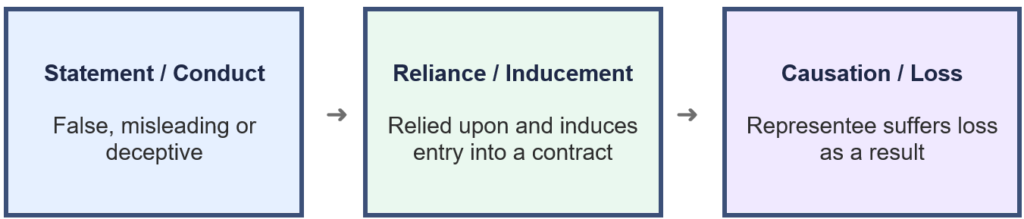
At the core of any misrepresentation claim is a false, misleading or deceptive statement or conduct. What amounts to a misrepresentation varies by jurisdiction, but there is substantial common ground despite differing frameworks and terminology. English law recognises “implied misrepresentation”, while Middle Eastern and Australian laws expressly provide that certain conduct, including silence and representations as to future matters, may amount to a misrepresentation. English law starts from a relatively restrictive position – excluding statements of opinion, future intention, and silence. However, case law has developed some exceptions to these exclusions. For example, a statement of opinion can be a misrepresentation where it amounts to a statement of fact that the person making the statement genuinely holds that opinion. And silence can be a misrepresentation where there is an implied misrepresentation, or where a half-truth has been told which becomes a misrepresentation by virtue of what was left unsaid. In substance, broadly similar behaviour may give rise to misrepresentation claims in each jurisdiction.
The next ingredient is reliance, sometimes referred to as inducement. First, the party making the misrepresentation claim must have been entitled to rely upon the statement. The key question in this regard is whether the reliance was reasonable in the circumstances: in all the jurisdictions considered in this article, marketing bluster or “sales puff” is insufficient, as are bare statements of intent or commitments to use best endeavours. Second, the false statement or misleading conduct must have, as a matter of fact, induced the other party to enter into the contract. The misrepresentation need not be the sole reason for entering the contract – it is enough that it played a real and substantial part in the decision to contract.
Finally, the claimant must have suffered loss as a result of entering into the contract (i.e. causation). If no loss has been suffered, or if the alleged loss is not sufficiently linked to the claimant’s reliance on the misrepresentation, the claim will fall away, notwithstanding all other matters being proven.
England & Wales
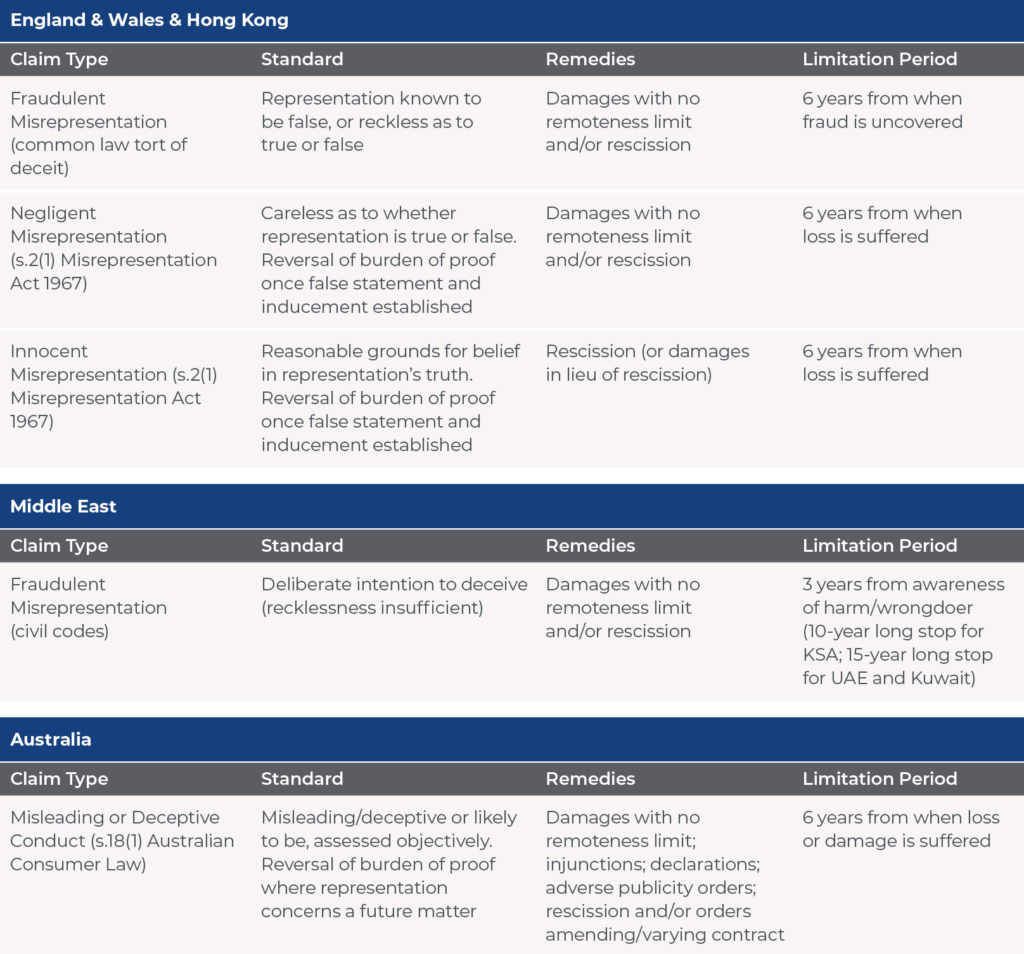
A distinctive feature of English law is the recognition of three categories of misrepresentation:2 fraudulent, negligent and innocent.
- Fraudulent misrepresentation is part of the tort of deceit and requires the representor to have known that the representation was false, or to have been reckless as to whether it was true or false.
- By contrast, negligent misrepresentation is founded on the Misrepresentation Act 1967 and requires the representor to have been careless or to have had no reasonable grounds to believe the representation was true – but they may still have believed the statement to be true themselves.
- Innocent misrepresentation (also a creature of the Misrepresentation Act) is where the representation was false, but the representor had reasonable grounds for believing the representation was true.
These three categories have different legal foundations, different legal tests, and result in different remedies being applied.
The English categories of misrepresentation have been influential in the development of the law in Australia and Hong Kong, although the law has evolved and, in some instances, diverged from the English position.
Australia
In Australia, while fraudulent, negligent and innocent misrepresentation are recognised at common law, misrepresentation claims in commercial disputes are usually brought under a single statute – the Australian Consumer Law (ACL) – which prohibits “misleading or deceptive conduct” (MDC). Section 18(1) provides that “a person must not, in trade or commerce, engage in conduct that is misleading or deceptive or is likely to mislead or deceive“. Section 4(1) provides that a representation with respect to a future matter, if made without reasonable grounds, will be taken to be misleading unless evidence is adduced to the contrary.
Unlike consumer protection laws in other parts of the world, the ACL is not confined to the protection of individual “consumers” from corporations. The prohibition on MDC applies equally to individuals and corporations, provided the conduct occurs in trade or commerce – generally straightforward to establish in commercial disputes.
The more pertinent question is whether the conduct is misleading or deceptive, or likely to be. Fraud or an intention to mislead is not required for a misleading or deceptive conduct claim – conduct “likely” to mislead or deceive is enough. This renders the Australian MDC claim broad enough to capture fraudulent, negligent and innocent misrepresentations alike.
Hong Kong
Hong Kong law is materially aligned with English law. The Hong Kong Misrepresentation Ordinance (Cap 284) closely reflects the English Misrepresentation Act, and Hong Kong courts regularly rely on English judicial authorities and legal texts. Hong Kong recognises the same three categories of misrepresentation as English law – fraudulent, negligent and innocent – with a substantially similar legal distinction between them.
Middle East (UAE, KSA and Kuwait)
The law on misrepresentation in the UAE, KSA and Kuwait is primarily governed by each country’s civil code, derived from civil and Sharia law principles. Unlike England & Wales, Australia and Hong Kong, courts in these jurisdictions are not bound by precedent, allowing greater scope for differing interpretations and, consequently, less certainty as to what conduct might constitute an actionable misrepresentation.
Despite this different legal framework, where a party is induced to enter a contract by a fraudulent misrepresentation, the result may be similar to that in the other jurisdictions. The civil codes of the UAE, KSA and Kuwait each expressly provide remedies for fraud-induced contracts, though “fraud” may be interpreted more narrowly than in England & Wales or Australia – generally requiring a deliberate intention to deceive rather than simple recklessness. Unlike the other jurisdictions considered, the UAE and KSA civil codes also provide remedies for bad-faith negotiation (including deliberately withholding material information) even where no contract is ultimately concluded.
However, in the UAE, KSA and Kuwait, if a party is induced to enter a contract by an innocent or negligent misrepresentation, there is no clear route to pursue a claim.
How would this play out in practice?
Returning to our hypothetical scenario, would the Employer’s statement in the Invitation to Tender that “the reference design is complete and fully co-ordinated” constitute a misrepresentation in each jurisdiction? While the Employer may seek to challenge the reasonableness of the Contractor’s reliance on a reference design, the Contractor’s claim should focus on the Employer’s unqualified statement that the reference design is “fully co-ordinated”.
In England & Wales, the Employer’s statement would likely be a misrepresentation, with the category depending on the Employer’s state of mind and knowledge of the design’s true status. Knowledge of the statement’s falsity, or recklessness as to its truth, would point to fraudulent misrepresentation. Carelessness without reasonable grounds for belief would point to negligent misrepresentation. Reasonable grounds for believing the design was co-ordinated and complete would point to innocent misrepresentation. The Contractor would, however, still have to prove reliance and inducement.
In Hong Kong, the position would likely be the same as in England & Wales.
In the UAE, KSA or Kuwait, a fraud claim would require the Contractor to prove the Employer’s statement was deliberate and intended to deceive.
In Australia, the Contractor’s claim would likely succeed regardless of the Employer’s knowledge, given this is a representation of present fact, and since fraud or intent to deceive are not required to establish MDC. The statement was likely to mislead or deceive, which is sufficient as MDC is not fault-based.
Burden and standard of proof
The claimant generally bears the burden of proof for establishing that a false statement has been made, across all the jurisdictions covered in this series. That starting point is consistent, save for the limited circumstances addressed below where the burden of proof is reversed onto the defendant. What varies – sometimes significantly – is what the claimant must prove and how much evidence is required to prove it.
In England & Wales, the Middle East and Hong Kong, the courts will take a cautious approach to fraud: they will not lightly conclude that a party has acted dishonestly. In England & Wales and Hong Kong, the balance of probabilities technically applies, but hard evidence is required before a finding of fraud is made. The Middle East has no separately articulated or quantified standard of proof, but courts there are equally reluctant to find fraud without clear evidence of intentional deception. In Australia, it may be easier to establish misrepresentation as MDC does not require dishonesty. For misrepresentations of fact, liability for MDC is assessed objectively – the defendant’s state of mind is irrelevant, and the claimant need only show that the conduct was objectively misleading or deceptive, or likely to be so. For misrepresentations of future matters, a defendant’s state of mind is relevant to MDC; however, a defendant can still be liable even where they had reasonable grounds for making the representation.
A unique feature of misrepresentation claims in England & Wales, Hong Kong and Australia is the reverse burden of proof: in certain circumstances, the burden shifts from the claimant to the defendant. In England & Wales, this shift occurs for negligent and innocent misrepresentation once the claimant has established that the representation was false and induced entry into the contract. This is also the case for statutory (negligent) misrepresentation in Hong Kong. In Australia, it occurs where the representation concerned a future matter. In these jurisdictions, once reversed, the defendant must prove it had reasonable grounds to believe the representation was true when made – a significant tactical advantage for claimants, who thereby shift part of the burden of prosecuting the claim onto their opponent.
How would this play out in practice?
So in our hypothetical situation, the Contractor bears the burden of proof across all jurisdictions to prove that the Employer made the statement about the reference design being “fully coordinated” and that the statement was false.
If the Contractor proves this, then under Australian law it has discharged its burden of proof. This is because misleading and deceptive conduct is assessed objectively, which renders the Employer’s state of mind irrelevant to liability for misleading or deceptive statements of present fact.
Under English and Hong Kong law however, for negligent and innocent misrepresentation, the burden shifts to the Employer to prove that it had reasonable grounds for believing the design to be complete and co-ordinated. If, for example, the Employer was informed by its design consultant that the reference design was complete and co-ordinated and passed that information on to the Contractor, it would likely be found to have had reasonable grounds for believing its statement to be true, and this would be an innocent misrepresentation (although the Employer may have its own misrepresentation claim against its design consultant). If the Employer fails to discharge the burden of proving it had reasonable grounds for believing the statement, then this would be a negligent misrepresentation.
For English law and Hong Kong law fraudulent misrepresentation claims, there is no reversal of the burden of proof. If our Contractor were bringing a claim for fraudulent misrepresentation, it would be required to prove (on the balance of probabilities) that the Employer knew the statement was false or was reckless as to the truth of the statement. Similarly, in the Middle East, intentional deception would need to be shown to prove fraud.
Remedies for misrepresentation
Where misrepresentation is successfully established, the primary remedy will generally be rescission of the contract and/or damages. In addition to damages under section 236 of the ACL, claimants under Australian law can also seek injunctions, declarations, adverse publicity orders, or orders amending or varying contract terms, as part of the broad framework of remedies available under the ACL.
Practically speaking, rescission brings the contract to an end – but it goes further than termination. It seeks to undo the contract and restore the parties, so far as possible, to the position they were in before the contract was entered into. In England & Wales and Hong Kong, rescission is the only available remedy for innocent misrepresentation and is available at the court’s discretion in lieu of damages for fraudulent and negligent misrepresentation. In the UAE, KSA and Kuwait, rescission is a primary remedy for fraudulent misrepresentation (alongside payment of damages). In practice, however, this is not always achievable: by the time a construction misrepresentation claim is made, significant work will typically have been carried out, materials incorporated, and payments made and received on both sides, so unwinding the contract entirely is rarely practicable and damages are the more appropriate remedy.
Damages payable for a successful misrepresentation claim aim to restore the claimant to the position it would have been in had the misrepresentation not been made and the contract not been entered into. These damages can be very extensive. Where damages are available, claimants may be able to recover losses on a more generous basis than a breach of contract claim. In England & Wales, for example, claimants can claim all of their losses arising from an entire project (known as a “total loss” claim) where fraudulent or negligent misrepresentation is established. In Australia, “no contract” claims offer a similar recourse for misleading and deceptive conduct, as do “alternative contract” claims, where claimants allege that they would have entered into the contract on better terms and at a price proportionate to the risks had they known the relevant conduct was misleading or deceptive.
In England & Wales (fraudulent and negligent misrepresentation), Hong Kong and Australia, the damages assessment is not subject to a remoteness limit. This means the loss does not need to be foreseeable at the time of entry into the contract to be recoverable. This creates the possibility of recovering a broader category of losses than in a traditional breach of contract claim, where recoverable losses must be foreseeable or a natural consequence of the breach.
Australian courts have recently adopted varying approaches when considering expectation losses in misleading or deceptive conduct claims. Damages for loss of profits – representing the value of alternative opportunities which could have been pursued but for the misrepresentation – may therefore be available under Australian law.
In all these jurisdictions, “fraud unravels all”. This means that contractual exclusive remedy provisions and liability limits are not applicable where fraud is proven (although these will still apply for actions in negligent misrepresentation). In Australia, parties cannot contract out of the ACL, irrespective of whether the relevant misleading or deceptive conduct was fraudulent or not. There is however a live question as to the enforceability of temporal and monetary limits to regulate (as opposed to exclude) the operation of the ACL. Superior Australian courts appear to diverge on the question.
Limitation periods however, present a bar to claims not brought within the prescribed time. In England & Wales, the limitation period is six years from the date on which loss was suffered for innocent or negligent misrepresentation; for fraudulent misrepresentation, time begins to run when the claimant uncovers the fraud. That is also the position in Hong Kong, where the limitation period is six years from when the relevant facts giving rise to the claim are discovered (or could with reasonable diligence be discovered). Australia also has a six-year limitation period; however, time begins when the cause of action accrues (i.e. when loss or damage is first suffered). In the UAE and Kuwait, there is a three-year limitation period running from the date the claimant becomes aware of the harm and the identity of the person responsible, subject to a long stop of 15 years from the date of the harmful act itself. KSA is the same, except that the long-stop period is ten years.
How would this play out in practice?
Misrepresentations are arguably most prevalent at the tender stage of projects, where inaccuracies inevitably compromise a contractor’s ability to accurately price its tender and assess the contractual risks it is willing to assume. Take the initial example of a contractor tendering for a project on the basis of the employer’s false statement that “the reference design is complete and fully co-ordinated”. As a result of the gaps and significant interface clashes in the reference design, the contractor would inevitably encounter substantial issues, resulting in it delivering the project at a loss. In those circumstances, rescission would be of little comfort to a contractor seeking to recover its financial losses.
So, what could our Contractor claim in damages? In England & Wales, the UAE, KSA, Kuwait, Hong Kong and Australia, the Contractor could claim its total loss on the project – in practice, the entirety of its costs under the Contract, less any sums already paid by the Employer. In Australia, the Contractor could alternatively claim an “alternative contract” value, reflecting the terms and price it would have contracted for had it known the conduct was misleading or deceptive. If the Employer’s misrepresentation also prevented the Contractor from proceeding with a different awarded project, an Australian court could award expectation losses for the forfeited profits on that project; the Contractor may be able to claim such losses in England & Wales as well.
Key takeaways
Misrepresentation claims offer a powerful avenue of recourse in construction and engineering disputes. While the fundamental ingredients – a false statement or misleading conduct, inducement and loss – are broadly consistent across England & Wales, the Middle East, Australia and Hong Kong, the legal frameworks, fault requirements and available remedies differ across these jurisdictions.
Below is a summary of the key points for misrepresentation claims in each of the four jurisdictions.
At the pre-contract stage, parties issuing tender documents, design briefs or investigation reports used to price or plan the works should carefully review such documents and related communications for accuracy. Boilerplate “no representation” and/or “no reliance” clauses do not offer complete protection – particularly where fraud is established.
Contractors and consultants receiving pre-contractual information should document their reliance on such information contemporaneously. Clear records of what was represented, when, by whom and in what form are the foundation of any misrepresentation claim. That evidence is always better preserved at the time of contracting than reconstructed years later when a dispute has crystallised.
Once a dispute arises, misrepresentation should be considered as a potential claim at an early stage. Access to broader categories of loss than conventional contractual or tortious claims, and the ability to overcome contractual exclusions and limits, can shift the tactical dynamics of a dispute. The prospect of a “total loss” or “no contract” / “alternative contract” damages claim can materially affect the settlement parameters for both parties.
Rescission, while theoretically the primary remedy, is frequently unavailable in construction disputes by the time a claim is formulated. Damages will usually be the operative remedy. The measure of those damages depends on the category of misrepresentation established.
Jurisdiction matters immensely for dispute resolution. Parties experiencing difficulties on international projects should take early advice on the claims framework under the governing law of the contract, including the viability and value of a misrepresentation claim. A claim absent of fraud may be relatively straightforward in Australia under the ACL, or in England & Wales under negligent or innocent misrepresentation; a higher evidentiary bar exists in the Middle East, where intentional deception is generally required to pursue a misrepresentation claim.
Finally, time is of the essence. Limitation periods differ across jurisdictions and have different trigger points depending on the nature of the claim. For fraud-based claims, time generally begins when the claimant uncovers the fraud; where fraud is not in issue, time is likely to commence from the date a loss is suffered. Parties who suspect they have been induced by a misrepresentation should promptly seek specific advice on the applicable limitation period to avoid their claim being time-barred.
The next article in the series examines implied terms and the obligations imposed on parties by operation of law – a further body of rights that exists independently of the express contractual bargain.
Footnotes
- Beyond the contract: why extra-contractual remedies matter in construction disputes | HFW
- In some jurisdictions, an action for negligent misstatement is also available. This is outside the scope of this article.








Related insights


