
LMA updates its drafting for sustainability-linked loans: What has changed?
The peculiarity of Sustainability-linked loans (SLLs) is that it links the pricing of a facility to the borrower’s performance against agreed sustainability metrics. The loan tracks key performance indicators (KPIs) such as greenhouse gas emissions, renewable energy use or workplace safety, measured against specific sustainability performance targets (“SPTs”), such as cutting emissions by 30% by 2030, sourcing 80% of electricity from renewable sources or reducing the accident rate below an agreed threshold. Those KPIs and SPTs are fixed at signing, based on the borrower’s business, sustainability strategy and reporting position at that time. Yet an SLL facility may run for seven years or more, and each of those starting assumptions is capable of changing well before maturity.
That, in essence, is the drafting challenge: a seven-year financing leaves considerable scope for factual, regulatory and commercial circumstances underpinning the KPIs and SPTs to evolve, giving rise to a number of legal and drafting questions. What happens if, three years later, the company acquires a major business and its original emissions baseline no longer reflects the perimeter of the group? What if its sustainability strategy does not extend far enough to support credible targets for the full seven-year term? What if the borrower ceases to provide the information required by lenders to verify its performance, or repeatedly breaches its sustainability-related undertakings? What if a serious ESG incident calls into question whether the financing should continue to benefit from, or be described by reference to, a sustainability-linked label? And what if the financing needs to close before the parties have agreed the KPIs, SPTs and wider sustainability mechanics? These are precisely the types of issues addressed by the Loan Market Association (LMA) in its latest update to the drafting for SLLs. This article examines the key changes introduced by the revision of the draft provisions for sustainability-linked loans published by the LMA on 18 August 2026, and considers their practical implications for borrowers, lenders and arrangers.
First and foremost, to understand why the update matters, it is useful to recall how an SLL works and how the LMA drafting has developed.
Unlike a green loan, an SLL does not require its proceeds to finance a particular green project. Instead, the sustainability element sits within the terms of the financing itself. Under the Sustainability-Linked Loan Principles (SLLP), the financial and/or structural characteristics of the loan can vary depending on whether the borrower achieves predetermined sustainability objectives1.
Against that background, the LMA published its first Draft Provisions for Sustainability-Linked Loans on 4 May 2023. Before such date, there had been no standard-form LMA drafting for implementing the SLLP, resulting in inconsistent approaches across the market and, in some cases, uncertainty as to the interaction between sustainability mechanics and the finance document’s general covenant and default provisions. The 2023 provisions were intended to fill that gap by providing a common contractual starting point for SLL drafting2. Since then, market practice has continued to develop. It is in that context that, on 18 August 2026, the LMA published a revision of those provisions. The updated package includes (i) revised Draft Provisions for Sustainability-Linked Loans (the Provisions), (ii) an accompanying term sheet and (iii) a new Education Note, Provisions for Sustainability-Linked Loans: Promoting sustainability goals and preserving integrity (the Education Note). The revised materials aim to improve consistency and clarity, reflect developments in market practice and provide more developed tools for issues arising over the life of an SLL3.
A clearer system of contractual “guardrails”
The first point to understand is that not every sustainability-related problem calls for the same response.
If a borrower misses a sustainability target, that does not necessarily say anything about its ability to repay the loan. Equally, if an acquisition makes an existing target inappropriate, simply penalising the borrower does not solve the problem. And, in more serious cases, where the sustainability framework stops functioning altogether, a pricing adjustment may eventually become insufficient.
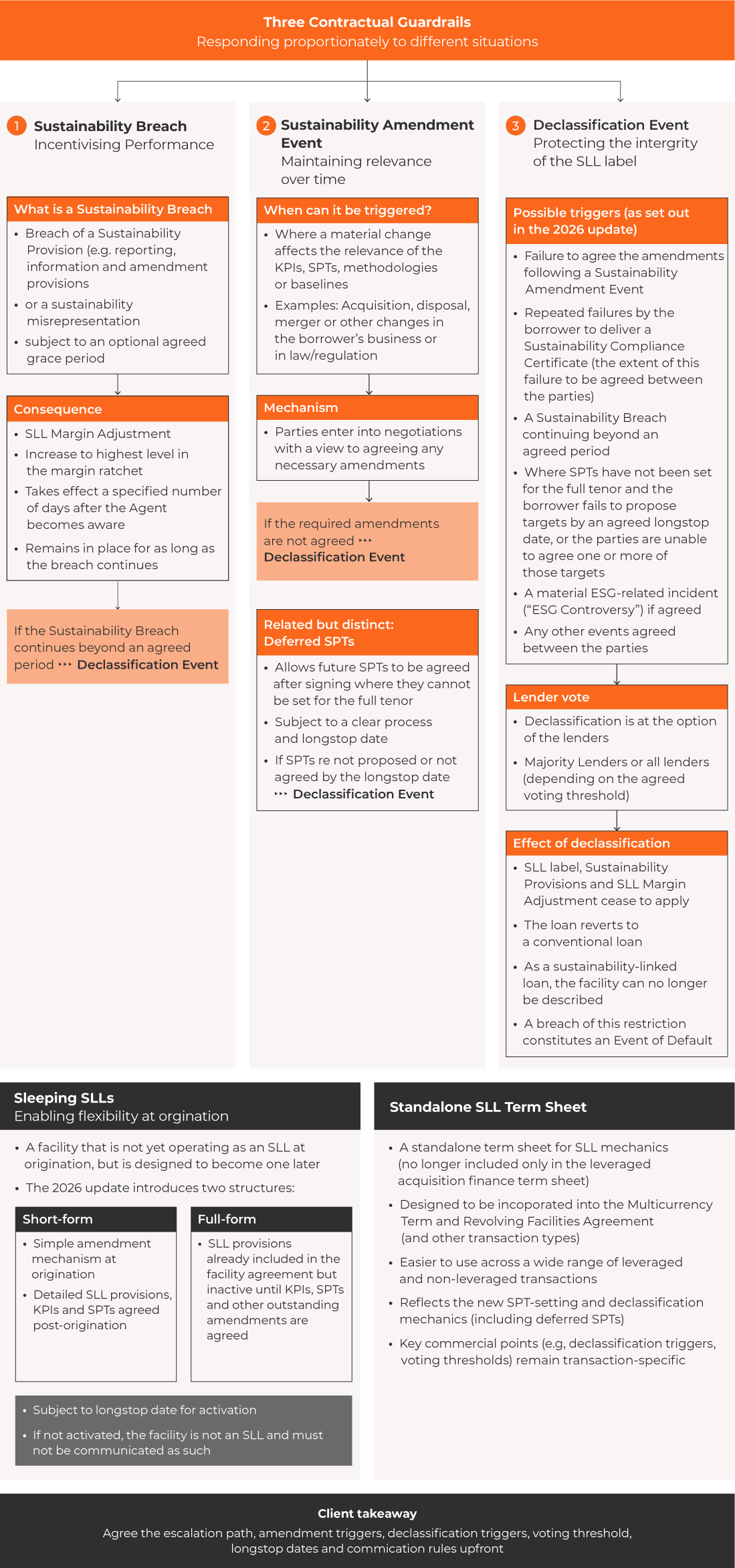
For that reason, the LMA structures the SLL provisions around three contractual mechanisms, described in the Education Note as “guardrails”:
- the Sustainability Breach regime, which gives a sustainability-related failure a financial consequence through the pricing of the loan;
- the Sustainability Amendment Event, which allows the parties to enter into negotiations to adjust KPIs, SPTs and related terms where the existing sustainability framework needs to change; and
- the Declassification Event, which raises the more fundamental question of whether the facility should continue to be treated as an SLL.
Although each mechanism has a distinct purpose, the LMA confirms that the guardrails are intended to operate together as an integrated framework and, depending on the circumstances, as a cascade. Such mechanism enables the parties to apply a response that is proportionate to the nature, seriousness and persistence of the relevant issue during the life of the financing. In simple terms, the available responses range from (i) an economic consequence, to (ii) contractual adjustment and, where the integrity of the sustainability-linked character of the facility can no longer be maintained, to (iii) declassification4.
Sustainability breaches: When pricing is no longer enough
Now, suppose a borrower is required to comply with a number of Sustainability Provisions. A sustainability breach occurs where there is either (i) a breach of a Sustainability Provision (which includes the sustainability reporting, information and amendment provisions) or (ii) a sustainability-related misrepresentation, in each case subject to any grace period. The revised version of the Provisions expressly confirms that no Event of Default will arise under the general “other obligations” or misrepresentation clauses by reason only of such a breach or misrepresentation, so that sustainability-related failures are channelled exclusively through the dedicated Sustainability Margin Adjustment and declassification mechanics rather than risking a cross-default or acceleration under the wider finance documents.
Under the model drafting, a Sustainability Breach typically triggers a Sustainability Margin Adjustment rather than an Event of Default, moving the margin to the highest level in the agreed SLL margin ratchet.
However, the 2026 drafting addresses a harder question: what should be the contractual consequence where the breach is continuing rather than temporary? A one-off reporting failure may be adequately addressed through pricing. By contrast, if the borrower persistently fails to provide the information required to assess its sustainability performance, lenders may no longer be able to substantiate the continued classification of the facility as sustainability-linked. For this reason, the revised Provisions include optional drafting under which a Sustainability Breach continuing beyond an agreed period becomes a Declassification Event. The key commercial question for the parties now is how long pricing protection should remain sufficient before declassification becomes available5.
Keeping sustainability targets relevant over time
Sustainability Amendment Events
A different problem arises where the activity of the borrower changes over the life of the loan. SPTs are agreed by reference to the borrower as it exists at a particular point in time. Consider a company whose KPI measures greenhouse gas emissions against an agreed baseline. If it sells a large part of its business, both its emissions and the structure of its operations may change substantially, with the result that the current KPI may no longer represent an appropriately ambitious performance target. Applying the original target without adjustment may no longer provide a meaningful measure of performance. One of the key functions of a Sustainability Amendment Event is to address this situation. The relevant events remain broadly linked to asset disposals, acquisitions or mergers which could reasonably be expected to materially affect a KPI or SPT. They also cover proposed changes to KPIs, SPTs, calculation methodology or baseline which could reasonably be expected to have that effect. Both triggers are subject to a materiality threshold: they are engaged only where there is a reasonable expectation of a material effect on a KPI and/or SPT, and in practice that threshold is sometimes further defined by reference to a financial metric, such as a percentage of turnover. This reflects that the amendment mechanism is intended to preserve the SLL where a genuine change in circumstances requires it, rather than to give the parties a general discretion to reopen the agreed metrics. The categories are not exhaustive: the parties may agree additional triggers, for example, where a change in the borrower’s sustainability strategy or in applicable law or regulation materially affects the sustainability metrics.
Once a Sustainability Amendment Event occurs, a negotiation period begins between the borrower and lenders with a view to agreeing any necessary amendments to the applicable KPIs, SPTs, calculation methodology, baseline or related provisions. The Education Note clarifies an important limitation: the mechanism is intended to preserve the integrity and relevance of the SLL framework following a genuine change in circumstances. It is not intended to operate as a discretionary re-opening of the agreed sustainability bargain merely because a target has become more challenging to achieve. The purpose is to keep the target meaningful and comparable, not to dilute its ambition.
Deferred SPTs
This mechanism is related to, but distinct from, the Sustainability Amendment Event mechanism. A different issue arises where credible SPTs cannot yet be set for the entire life of the loan, at the time of its signature.
For this purpose, the revised Provisions introduce optional drafting which allows the outstanding SPTs to be proposed post-signing. The parties then negotiate those targets with a view to reaching agreement by a specified longstop date. This may be particularly useful for longer-term facilities where the borrower’s sustainability strategy does not extend to the full maturity of the loan. The benefit is that the parties do not need to manufacture long-term targets simply to complete the documentation at signing. However, that flexibility has a limit: failure to propose or agree the deferred SPTs can itself constitute a Declassification Event. This builds directly on the SLLP Guidance, which already provides that, where SPTs for later years of a loan are never agreed, the loan should be declassified and no longer marketed as an SLL. The longstop date therefore gives the parties time to develop credible targets without allowing part of the sustainability framework to remain unresolved indefinitely6.
An expanded declassification framework
The next question is more fundamental: what happens when the sustainability framework can no longer support the SLL label itself? This is where declassification comes in. Declassification does not terminate the facility, accelerate the loan or otherwise affect the borrower’s payment obligations under the finance documents. Rather, the facility continues as a conventional loan, while the SLL-specific provisions and related pricing mechanics are disapplied in accordance with the relevant provisions of the loan agreement, and the facility ceases to be treated or described as sustainability-linked loan.
The 2023 Provisions provided for declassification where the parties failed to agree the amendments required following a Sustainability Amendment Event. They also included a placeholder allowing additional triggers to be agreed for a particular transaction.
Since then, however, market practice has developed. The revised Provisions now expressly include optional Declassification Events which have become common in market practice, including:
- a failure to propose or agree any deferred SPTs;
- a failure to deliver Sustainability Compliance Certificates for two SLL Reference Periods, whether consecutive or in aggregate; and
- a Sustainability Breach continuing beyond an agreed period.
In addition, the Education Note also discusses a further possibility. A material ESG-related incident, often defined as an “ESG Controversy”, may be used as an additional declassification trigger, particularly where the borrower operates in a higher-risk sector. The Provisions do not contain standard drafting for such a trigger, leaving its inclusion and scope to the parties7.
How does declassification work?
While the range of possible triggers has expanded, the declassification mechanism itself remains largely consistent with the 2023 Provisions.
The occurrence of a Declassification Event does not automatically remove the SLL label. Instead, it triggers a lender decision as to whether the declassification option should be exercised. Depending on the parties’ commercial agreement, that decision may be taken by the Majority Lenders or require the consent of all Lenders. That threshold is significant in a syndicated facility: an all-lender threshold gives each lender greater control over the sustainability-linked status of the facility, but may make collective action more difficult; a majority threshold is easier to operate, but reduces the ability of an individual lender to determine the outcome.
If lenders vote to declassify, the Sustainability Provisions cease to apply. The Sustainability Margin Adjustment ceases immediately for new Utilisations and, after an agreed run-off period, for outstanding Loans.
The Education Note also clarifies two practical points.
- First, declassification is not intended to give the borrower a unilateral right to leave the SLL structure. If the borrower wants to remove the sustainability-linked features, that request should instead be dealt with through the ordinary amendment process.
- Second, following declassification, the borrower must stop referring to the facility as “sustainability linked”. Importantly, that restriction is not itself categorised as a Sustainability Provision. A breach will therefore constitute an Event of Default under the general Events of Default provisions, rather than receiving the SLL-specific treatment afforded to Sustainability Breaches8.
This is an important distinction. A failure within the sustainability framework is generally dealt with through that framework. Continuing to claim the SLL label after the facility has been declassified is not.
“Sleeping” SLLs: When the financing is ready before the sustainability framework
So far, the revised Provisions have dealt mainly with problems that arise during the life of an SLL. But sometimes the timing problem arises before the facility is even signed. A refinancing may have a fixed deadline. An acquisition financing may need to close quickly and, at the same time, identifying suitable KPIs, establishing reliable baselines and agreeing sufficiently ambitious SPTs may take longer. The financing timetable and the sustainability timetable do not always move at the same speed.
The revised Provisions respond by introducing a new Part B containing dedicated drafting for “sleeping” SLLs, building on a mechanism already contemplated by the SLLP Guidance, under which SLL mechanics may be included in the documentation at signing and switched on once the KPIs and SPTs are agreed post-origination, provided the borrower gives a clear rationale for the deferral and discloses its existing sustainability strategy to the lender group. These are facilities where there is a legitimate rationale for not setting the KPIs and SPTs at origination, but where the parties intend to include a contractual pathway for the sustainability-linked features to become effective at a later stage.
Two approaches are proposed:
- under the “short-form” option, the facility contains a simple amendment mechanism and the SLL provisions are agreed post-origination alongside the KPIs and associated SPTs; and
- under the “full-form” option, the full SLL provisions are incorporated into the facility agreement at origination but remain inactive until the KPIs, associated SPTs and any other outstanding amendments have been agreed.
The choice will largely depend on how much of the sustainability framework can realistically be negotiated before closing. Both options are subject to a longstop date. The SLLP Guidance recommends that the KPIs and SPTs be agreed no more than 12 months post-origination and, where practicable, that all lenders give affirmative consent to their subsequent setting. Missing that date does not permanently prevent the facility from becoming an SLL: the parties may still agree a later conversion through the ordinary amendment process.
Sleeping SLL or deferred SPTs?
- With deferred SPTs, the facility is already an SLL. Its sustainability-linked framework is active, but some targets applying to later periods remain to be agreed. With a sleeping SLL, the sustainability-linked features themselves have not yet become effective.
- The SLLP Guidance is clear on the consequence. Where no KPIs and/or SPTs have been set before or concurrently with origination, the loan is not yet an SLL and should not be marketed as one. It can be referred to as an SLL only once the KPIs and SPTs are agreed and the other core components of the SLLP are met9. A sleeping facility may therefore contain the contractual route through which it will later become sustainability-linked. That route does not, by itself, give the facility the SLL label at origination.
A standalone SLL term sheet
The LMA has also restructured the accompanying term sheet. Previously, the sustainability-linked drafting was embedded in the LMA leveraged acquisition finance term sheet. The revised version is a standalone SLL document designed to be inserted into the LMA term sheet for the Multicurrency Term and Revolving Facilities Agreement.
The drafting has also been simplified, particularly around KPIs and the Sustainability Margin Adjustment, and updated to reflect the expanded list of Declassification Events and the new SPT-setting mechanism. With appropriate amendments, the term sheet can also be adapted for non-leveraged transactions10. The change is technical, but practical: it makes the term sheet easier to use across a broader range of financings.
Conclusion
The 2026 update is a targeted refinement rather than a redesign of the SLL product. Its main contribution is a more complete contractual response to situations which arise in real transactions after the original sustainability mechanics have been agreed.
A borrower may change. Its original baseline may cease to be appropriate. Its sustainability strategy may not extend across the full tenor of the loan. Reporting obligations may be breached. The financing may need to close before the SLL terms are fully developed. In some circumstances, the sustainability framework may no longer justify the label attached to the facility. The revised Provisions provide clearer contractual tools for each of those situations. The new SPT-setting mechanism gives parties greater flexibility where credible future targets cannot yet be established. The expanded Declassification Events formalise triggers which have developed in market practice. The new sleeping SLL drafting allows a financing to proceed where the sustainability mechanics require further development. Important commercial choices nevertheless remain. Trigger events, cure periods, longstop dates, lender voting thresholds and the consequences of declassification will continue to require transaction-specific negotiation. The central question for an SLL is therefore not simply how to attach a sustainability-linked label at signing, but how to ensure that the contractual framework supports that label, and preserves its integrity, throughout the life of the loan.
A summary of the key concepts discussed above and their practical implications is set out in the Annex.
Mamoune Zizi, Stagiaire, assisted in the preparation of this briefing.
Annex
| Key concept | What it means | Key development in 2026 | Practical takeaway for parties |
|---|---|---|---|
| Sustainability Margin Adjustment | Pricing mechanism linking the loan margin to sustainability performance and, under the model drafting, to certain Sustainability Breaches. | No fundamental redesign, but its role within the wider system of contractual “guardrails” is clarified. | Agree clearly when sustainability performance should affect pricing and how the margin ratchet interacts with other remedies. |
| Sustainability Breach | Breach of a Sustainability Provision, e.g. failure to provide required sustainability information or a sustainability-related misrepresentation. | Optional drafting allows a Sustainability Breach continuing beyond an agreed period to become a Declassification Event. | Define the breach and cure period upfront, and decide when a persistent failure should escalate from pricing to possible declassification. |
| Sustainability Amendment Event | Allows KPIs, SPTs, methodologies or baselines to be reconsidered where a material change affects their relevance. | The Education Note clarifies that the mechanism is intended to preserve the relevance of the SLL after genuine changes in circumstances, not to soften difficult targets. | Draft clear amendment triggers and governance so the framework can adapt without undermining the ambition of the original targets. |
| Deferred SPTs | Allows certain future SPTs to be agreed after signing where credible targets cannot yet be set for the full tenor. | New optional drafting expressly allows outstanding SPTs to be proposed post-signing and agreed by a longstop date. Failure to propose or agree them may trigger declassification. | Avoid speculative long-term targets; instead agree a clear timetable, process and consequence if future SPTs are not agreed. |
| Declassification Event | An event giving lenders the option to remove the sustainability-linked status of the facility. | Optional triggers are expanded to include persistent Sustainability Breaches, failure to agree deferred SPTs and repeated failure to provide Sustainability Compliance Certificates. The Education Note also discusses possible ESG Controversies. | Agree the triggers carefully and tailor them to the borrower, sector and risk profile. |
| Declassification mechanics and effects | A Declassification Event does not automatically declassify the facility; lenders must exercise the option. If declassified, the SLL mechanics cease but the loan continues. | The materials clarify lender voting, pricing consequences, run-off mechanics and post-declassification communications. | Agree the voting threshold, run-off period and communication obligations upfront. After declassification, continuing to describe the facility as sustainability-linked can constitute an Event of Default, subject to any grace period. |
| Sleeping SLLs | A facility that is not yet operating as an SLL at origination but is designed to become one later. | New Part B introduces short-form and full-form structures, each subject to a longstop date. | Use a sleeping SLL where the financing must close before the sustainability framework is ready, but do not market the facility as an SLL before activation. |
| Standalone SLL term sheet | Dedicated term-sheet drafting for SLL mechanics. | Now standalone and designed to be incorporated into the Multicurrency Term and Revolving Facilities Agreement term sheet, with broader use across leveraged and non-leveraged transactions. | Use it as a flexible starting point, but keep key commercial points (especially declassification triggers, voting thresholds and deferred SPTs) transaction-specific. |
Footnotes
- Loan Market Association, Sustainability-Linked Loan Principles, 26 March 2025, “Sustainability-Linked Loan Definition” and “Core Components”; see also Guidance on Sustainability-Linked Loan Principles, 26 March 2025, sections 2.A and 3.A. Sustainability-Linked_Loan_Principles_-_26_March_2025_.pdf / Guidance_on_Sustainability-Linked_Loan_Principles_-_26_March_2025.pdf
- Loan Market Association, LMA publishes model provisions for sustainability-linked loans, 4 May 2023. Loan Market Association – Press Releases
- Loan Market Association, LMA Publishes Updated Draft Provisions for Sustainability-Linked Loans, Term Sheet, and New Accompanying Educational Note, 18 August 2026; Loan Market Association, Documentation Hub, Draft Provisions for Sustainability-Linked Loans, Provisions for Sustainability-Linked Loans Education Note and Term Sheet for Draft Provisions for Sustainability-Linked Loans, each dated 18 August 2026. Sustainable Lending Microsite :: LMA / Documents / https://www.lma.eu.com/application/files/9717/8704/1794/LMA_Provisions_for_Sustainability-Linked_Loans_Education_Note.pdf / LMA_Sustainability-Linked_Loans_Term_Sheet.docx
- Loan Market Association, Provisions for Sustainability-Linked Loans: Promoting sustainability goals and preserving integrity, August 2026, pp. 1-2. https://www.lma.eu.com/application/files/9717/8704/1794/LMA_Provisions_for_Sustainability-Linked_Loans_Education_Note.pdf
- Loan Market Association, Provisions for Sustainability-Linked Loans: Promoting sustainability goals and preserving integrity, August 2026, p. 2. https://www.lma.eu.com/application/files/9717/8704/1794/LMA_Provisions_for_Sustainability-Linked_Loans_Education_Note.pdf
- Loan Market Association, Provisions for Sustainability-Linked Loans: Promoting sustainability goals and preserving integrity, August 2026, p. 3; Loan Market Association, Asia Pacific Loan Market Association and Loan Syndications and Trading Association, Guidance on Sustainability-Linked Loan Principles, 26 March 2025, pp. 8-10. Guidance_on_Sustainability-Linked_Loan_Principles_-_26_March_2025.pdf
- Loan Market Association, Provisions for Sustainability-Linked Loans: Promoting sustainability goals and preserving integrity, August 2026, p. 4. https://www.lma.eu.com/application/files/9717/8704/1794/LMA_Provisions_for_Sustainability-Linked_Loans_Education_Note.pdf
- Loan Market Association, Provisions for Sustainability-Linked Loans: Promoting sustainability goals and preserving integrity, August 2026, p. 5; Loan Market Association, Draft Provisions for Sustainability-Linked Loans, 18 August 2026. https://www.lma.eu.com/application/files/9717/8704/1794/LMA_Provisions_for_Sustainability-Linked_Loans_Education_Note.pdf / Documents
- Loan Market Association, Asia Pacific Loan Market Association and Loan Syndications and Trading Association, Guidance on Sustainability-Linked Loan Principles, 26 March 2025, p. 8; Loan Market Association, Draft Provisions for Sustainability-Linked Loans, Part B, 18 August 2026. Documents
- Loan Market Association, Term Sheet for Draft Provisions for Sustainability-Linked Loans, 18 August 2026. LMA_Sustainability-Linked_Loans_Term_Sheet.docx


Related insights


